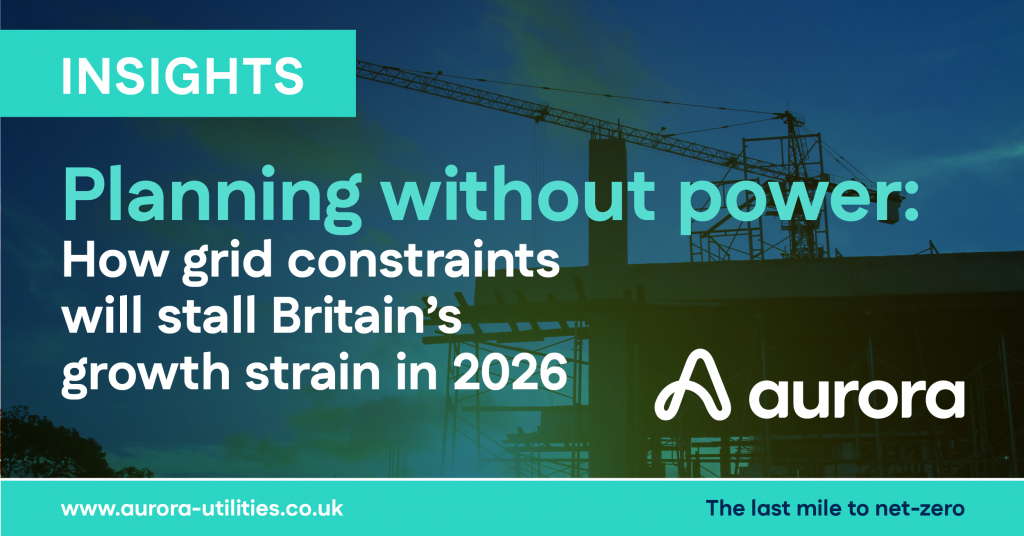
Infrastructure demand across the UK is set to intensify sharply in 2026. The rapid expansion of data centres, a growing stock of ageing energy assets approaching end-of-life, and the urgent need to build climate-resilient networks are converging at pace.
Together, these pressures underline a fundamental shift: energy infrastructure no longer operates in isolation.
Nowhere is this more visible than in the UK’s accelerating push to become a global hub for artificial intelligence and digital services.
Data centres move to the centre of the system
Nearly 100 new data centre developments are expected to come forward in the UK over the next five years, as government and technology companies increasingly position AI as a cornerstone of economic growth.
Globally, the International Energy Agency estimates that electricity demand from data centres could more than double by 2030, driven primarily by AI training, cloud computing and high-performance workloads – with advanced economies facing the sharpest localised impacts.
Reflecting this shift, the UK Government formally designated data centres as critical national infrastructure following the most recent general election – a clear signal that digital infrastructure is now viewed as strategically comparable to energy, transport and water.
Ministers have since set out proposals for ‘AI Growth Zones’, inviting local authorities to express interest in hosting large-scale digital infrastructure as part of a more coordinated national approach. But designation alone does not solve the delivery challenge.
A step-change in energy demand
The pace and scale of data centre development represents one of the most material demand shifts facing the energy system this decade. Connecting a new site is not a marginal upgrade. Large data centres often require tens to hundreds of megawatts of firm capacity, alongside substantial investment in local substations, high-capacity cabling and, in many cases, upstream network reinforcement.
By 2026, grid connection timelines and local capacity constraints are becoming as critical to project viability as land or planning consent.
At this scale, location decisions matter. Poorly located facilities risk overburdening local electricity networks, water resources and transport systems, with knock-on impacts for nearby housing, mobility and public services. The consequences extend well beyond the site boundary.
Nor is site selection simply a question of land availability. Many proposed developments are located on industrial or brownfield land near water sources, but proximity alone is insufficient. Planners must assess whether water supplies have the quality and volume required for cooling, whether treatment or recycling is needed, and what that implies for cost, resilience and environmental impact.
Legacy land use adds further complexity. Can existing roads, substations, sewers and communications infrastructure support a high-intensity facility? Is there access to a skilled workforce, and can local transport systems absorb additional demand? Without credible answers, growth risks outpacing the capacity of surrounding systems to support it sustainably.
The rise of new energy alliances
Against this backdrop, the transition to cleaner energy sources is beginning to reshape commercial relationships.
Our recent research report suggests that three in ten developers are already actively pursuing partnerships with data centres or other high-demand users, developing co-located generation projects such as solar farms or battery storage. These arrangements can reduce grid dependency, improve connection certainty, and align long-term energy supply with digital demand.
A further 39% are considering similar collaborations, underscoring how quickly the market is adapting to a world in which energy supply and digital infrastructure are increasingly intertwined.
Just 6% of respondents said they would not consider such partnerships at all – a clear indication that cross-sector collaboration is rapidly becoming a strategic norm rather than a niche solution.
From coexistence to coordination
By 2026, the question is no longer whether data centres and energy developers will interact – but how deliberately and strategically they do so.
Co-location, shared infrastructure, behind-the-meter generation and flexible demand are no longer optional optimisations. They are emerging as essential tools for delivering digital growth without overwhelming constrained local systems.
In a world of tightening grid capacity, rising demand and heightened scrutiny on infrastructure investment, partnerships are becoming the mechanism that turns constraint into opportunity.
The future of AI, digital growth and clean energy will not be built in parallel – it will be built together.