
Client: Russell Group, a leading UK logistics and transport operator with a long-term commitment to decarbonising freight operations across road and rail networks.
Project focus:
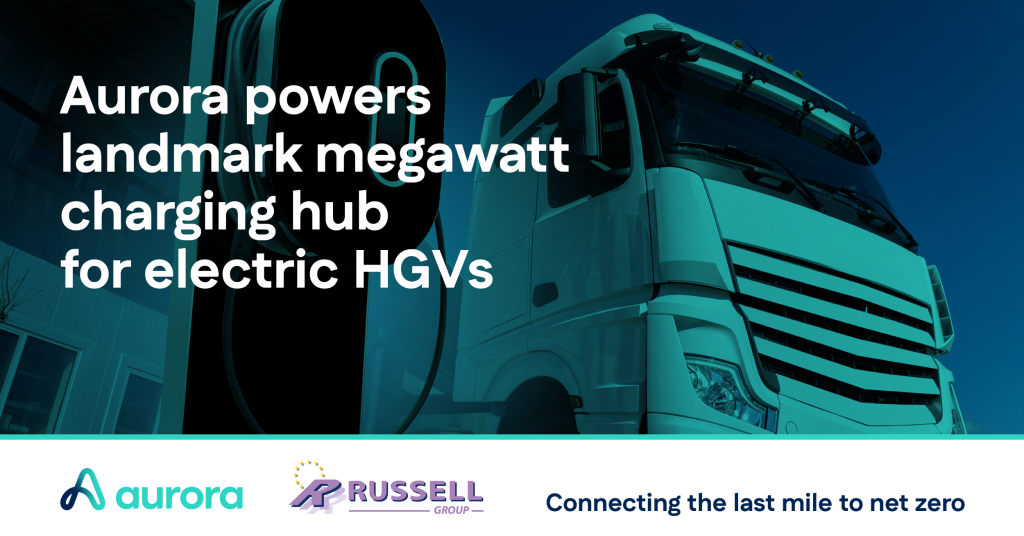
Aurora was appointed as the Independent Distribution Network Operator (IDNO) for one of the UK’s most significant heavy transport electrification projects: the delivery of a megawatt-scale charging hub to support battery-electric heavy goods vehicles (HGVs) at Russell Group’s operations in Coatbridge, North Lanarkshire, Scotland.
The project enables the deployment of next-generation electric HGVs capable of transporting full 42-tonne loads while supporting ultra-fast charging turnaround times required for commercial freight operations. The infrastructure forms a critical part of Russell Group’s wider strategy to achieve net zero across its transport and warehousing operations by 2040.
The challenge:
Electrifying heavy freight presents a far greater infrastructure challenge than standard EV charging projects. Unlike passenger vehicle charging, megawatt-scale freight charging requires exceptionally high-capacity electrical infrastructure, robust network resilience, and carefully coordinated delivery to ensure operational viability for commercial logistics fleets.
Russell Group required infrastructure capable of supporting rapid charging for battery-electric HGVs without disrupting depot operations or fleet utilisation. To make electric freight commercially viable, charging needed to align with driver rest breaks and logistics schedules, demanding a network solution capable of delivering extremely high levels of power safely and reliably.
The project also required coordination across multiple technical stakeholders, alongside the integration of high-voltage charging assets designed to support future Megawatt Charging System (MCS) upgrades. Delivering this level of infrastructure at pace required an IDNO partner capable of managing complex network adoption processes, energisation requirements, and long-term operational resilience.
In addition to the engineering complexity, the project carried broader strategic importance. As the logistics sector accelerates towards decarbonisation, infrastructure delivery timelines are becoming increasingly critical.
Any delays getting the charging infrastructure connected to the grid would risk slowing the adoption of electric HGV fleets, and impacting wider sustainability commitments across the supply chain.
The solution:
Connected by 1st June 2026, Aurora played a central role as the IDNO partner responsible for enabling and supporting the delivery of the high-capacity electrical infrastructure required for the charging hub.
By applying a proactive and coordinated delivery model, Aurora ensured the network infrastructure could support megawatt-scale charging demands while maintaining the resilience and operational reliability required for a live logistics environment.
Our impact
The project supports charging infrastructure enabling electric HGVs to recharge in approximately 40 minutes using current CCS charging technology, with future MCS upgrades expected to reduce charging times to 20 minutes.
Aurora’s expert team ensured the electrical infrastructure was future-ready, scalable, and aligned with Russell Group’s long-term electrification strategy.
Through close collaboration across project stakeholders, Aurora helped accelerate the deployment of infrastructure capable of supporting the next generation of zero-emission freight transport in the UK.
The completed charging hub now provides a blueprint for how high-capacity electrical infrastructure can enable the wider rollout of electric HGV operations nationally. By supporting scalable freight electrification, Aurora is helping remove one of the key barriers to decarbonising heavy transport at scale.
Testimonial:
“Projects like this show how critical the role of an IDNO has become in enabling large-scale transport electrification. Delivering megawatt charging infrastructure requires a network partner that can move quickly, coordinate complex energisation requirements, and provide the long-term resilience needed for high-demand operational environments.
– Stephen Madden, Head of Engineering at Russell Group- Stephen Madden, Head of Engineering at Russell Group
“At Aurora, we’re focused on helping fleet operators like Russell Group accelerate deployment timelines while connecting the scalable electrical infrastructure needed to support the future of zero-emission freight across the UK.”
– Mark Sneddon, Delivery Director at Aurora