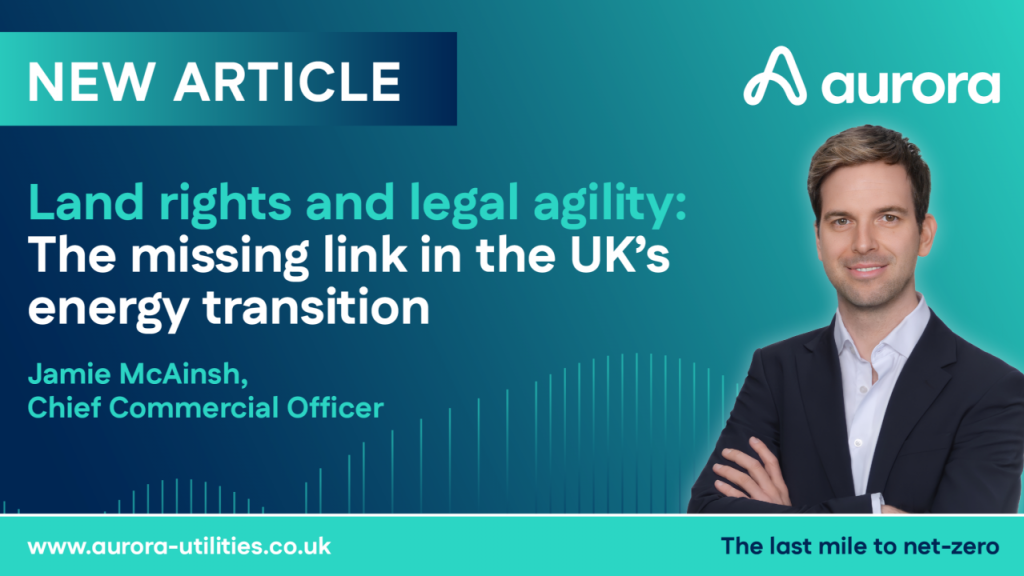
Jamie McAinsh, Chief Commercial Officer of Aurora Utilities Limited
The UK’s energy transition is gathering pace. From EV charging networks to renewable generation and data infrastructure, the demand for grid connections is soaring. But amid the buzz around solar farms and battery storage, there’s a less visible challenge stalling progress: land rights.
At Aurora, we’re at the forefront of addressing this critical bottleneck. As a licensed Independent Distribution Network Operator (IDNO), we’ve built a highly-experienced, specialist in-house legal team to tackle the often-overlooked legal complexities that can make or break energy infrastructure projects. Our mission is to drive efficiency in one of the most delay-prone corners of the utility sector, and that starts with land.
The silent saboteur: Legal delays in land access
Despite the UK Government’s Powering Up Britain strategy which aims for rapid grid reform, land access negotiations remain frustratingly slow. At least £725 billion of government funding over the next decade has been earmarked for new infrastructure and upgrades, which will see the issue balloon in scale in the coming years.
From our own experience, and echoed across the industry, standard completion times for substation leases in commercial and industrial contexts often stretch to six months or more. In some legacy organisations, transactions have been known to drag on for over two years. Why? Because infrastructure developers rarely deal with a single party.
Instead, there’s a chain: freeholder, leaseholder, tenant, charge point operator. Each with their own lawyers, each with limited (or no) experience negotiating substation leases.
The Aurora approach: Building in-house legal expertise
At Aurora, we’ve intentionally moved away from the industry norm of relying solely on outsourcing legal work to external consultants; specifically building an in-house team who are experts in securing land rights. While external solicitors are often juggling hundreds of clients and driven by billable hours, our in-house team managing the often complex process of negotiating land rights and timely access to key sites are fully aligned with the operational goals of the business: speed, consistency, and clarity.
Our in-house legal team who are highly experienced in the area of land rights is headed up by Alex Lane (formerly of international law firm, CMS, and who brings a wealth of experience in renewables), supported by Laura Simons (with a strong IDNO background), and Joyce Wilson (who spent years at BP in the legal department focused on the growth of their high-speed charging points).
Our team blends deep sectoral knowledge with agility. More importantly, we eliminate the dreaded “legal ping-pong”; weeks lost to back-and-forth correspondence on minor clauses, often between parties who aren’t aligned on deal objectives or even speaking the same commercial language.
The result? We’ve reduced average legal completions from the typical six-month timeline to just 14 weeks, with standout cases closing in just five weeks thanks to Aurora’s slick legal processes, standardised documentation, and strong client relationships.
Why legal certainty matters for developers and ICPS
Our clients, many of whom are Independent Connection Providers (ICPs), often aren’t party to the lease negotiations, yet they shoulder reputational risk when timelines slip. With a backlog of projects awaiting energisation, they can’t afford to be told vaguely that “the lease is with the other side.”
Instead, we provide them with clarity: which clause is outstanding, who’s responsible, where the risk is, and what we’re doing to resolve it. Whether it’s an incorporated rights clause shared with a Distribution Network Operator (DNO) or access issues at a complex site, we bring the conversation to a resolution quickly.
Early legal engagement: A developer’s secret weapon
One of the most important ways we accelerate delivery is by starting the legal process earlier than anyone else in the market. While many IDNOs wait for full design approval before legal engagement begins, Aurora starts work the moment a project is confirmed.
We immediately begin developing Heads of Terms, reviewing precedent lease clauses, and identifying potential red flags. For repeat customers, we establish master documents that need only minor amendments for each new site; a tactic that saved weeks on a recent project for a client installing EV charging infrastructure nationwide.
Moreover, our legal team plays an active consultancy role for developers in the renewables and data centre sectors. Whether mapping cable routes across multiple landowners or providing advice on lift-and-shift clauses for farmers, we act as a partner, not just a stakeholder.
The case for legal-led disruption
The infrastructure landscape is changing. The UK has ambitious net zero targets, but achieving them will require a fundamental rethink of how land rights are secured, negotiated, and delivered. Aurora is proving that legal function can be a strategic differentiator, not a bottleneck. Our in-house model gives us control, insight, and speed, which we pass onto our clients.
Ultimately, the energy transition isn’t just about technology or policy. It’s about execution. And execution depends on people who can cut through complexity, build trust quickly, and keep projects moving at pace. Aurora’s in-house legal team is proud to be part of that mission; and we’re just getting started.