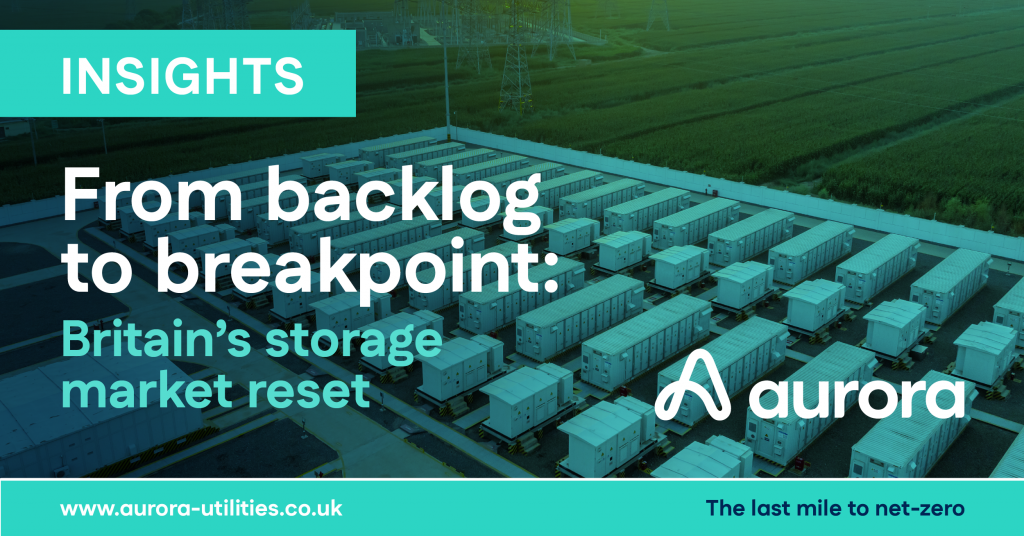
The UK’s storage market has entered a decisive new phase – and it starts with the National Energy System Operator’s (NESO) newly reformed grid connection pipeline.
Following its overhaul of the connection process, NESO will now issue offers through to 2035 for 283GW of projects, including a substantial volume of battery energy storage.
The results mark the most consequential reset of the storage pipeline to date – clarifying which projects move forward, which stall, and which may need to fundamentally rethink their role in the system.
For energy storage developers, the key question is no longer whether reform was needed – but what kind of storage now survives under it.
From backlog to bottleneck
Before the reform, the grid connection queue had swollen to around 722GW – nearly four times the capacity required to meet government renewable targets. So, reform was inevitable.
Solar Energy UK described the reforms as “painful but necessary” – an assessment that resonates most strongly in the storage sector. Battery energy storage systems (BESS) sit at the sharpest edge of reform.
Despite 83GW of BESS projects receiving Gate 2 offers, the pipeline remains oversupplied by 62GW by 2035. Of those Gate 2 projects, just 33GW will connect before 2030. Crucially, only BESS projects with ‘protected’ status – those that had already materially progressed before the queue reshuffle – will receive confirmed offers. As a result:
- 153GW of BESS projects were not prioritised, receiving Gate 1 offers or being removed entirely,
- It is unlikely that new BESS projects will secure grid capacity before 2035,
- Some protected projects have been pushed back in time but remain prioritised.
For short-duration batteries in particular, this marks a structural shift. Under the new readiness-based regime, many struggle to demonstrate strategic system value or delivery certainty at the scale required.
LDES: differentiated – and deliberately favoured
Long-duration energy storage (LDES) tells a different story.
LDES projects – typically defined as 8+ hours of storage – qualify differently under the new framework, and that nuance matters. Ofgem has already recognised LDES as essential national infrastructure, proposing a cap-and-floor revenue model to unlock investment and reduce risk.
Market momentum reflects this shift. According to RenewableUK, UK storage proposals rose from 7.2GW in 2023 to 10.5GW by mid-2024. The Clean Power 2030 roadmap suggests LDES capacity could reach 8GW by the 2030s, delivering an estimated £10 billion in system benefits.
Under NESO’s reformed process:
- LDES projects are effectively fully allocated through to 2035
- Prioritisation was based in part on application timing
- Just 5.6GW of LDES capacity was not prioritised
In a system dominated by intermittent renewables, storage is no longer an accessory. It is the anchor. The clock is now ticking and developers now face compressed decision timelines:
- A 90-day window to respond to transmission connection offers,
- Potentially shorter response windows at the distribution level,
- An expectation to challenge outcomes swiftly – but only with evidence-based claims or demonstrable process errors.
The next opportunity for new Gate 2 capacity was expected no earlier than Q2 next year, leaving many projects stranded in the meantime.
It is worth noting that NESO confirmed at the end of January that the Connections Reform delivery timeline is experiencing some delays due to the need to resolve newly identified technical and engineering issues. While some offer dates will shift, this is not a complete overhaul – and they said that their partners remain committed to issuing offers as early and reliably as possible, with a revised timeline expected soon.
The unexpected opportunity: repurposing stranded assets
One question is increasingly preoccupying developers: does a stranded project really have to die?
If a battery site loses its export rights, could it pivot instead to a demand-only role – supplying data centres, industrial users, or hydrogen production? Could this create a secondary market for grid access, where connection rights are effectively repurposed rather than abandoned?
Such flexibility opens a new design space – but also exposes regulatory gaps.
If two identical projects sit side by side and only one receives a connection, legal challenges are likely to follow. And while Ofgem’s rules on “material change” exist, their application remains murky.
For repurposing to work at scale, DNOs and NESO will need to apply pragmatic flexibility, allowing viable project pivots without automatically forcing assets to the back of the queue.
The long-duration endgame
What NESO’s pipeline makes clear is this: the era of speculative storage is over.
In its place is a system that rewards:
- strategic system value
- delivery certainty
- long-duration capability
- and alignment with net-zero system needs
For BESS, the market narrows. For LDES, the door opens wider. And, for developers across the board, 2026 will be less about queue position – and more about whether their project genuinely belongs in the system Britain is now building.
Read the full report here: