By Charlie Hesketh, Strategy & Investments Director at Aurora Utilities Limited
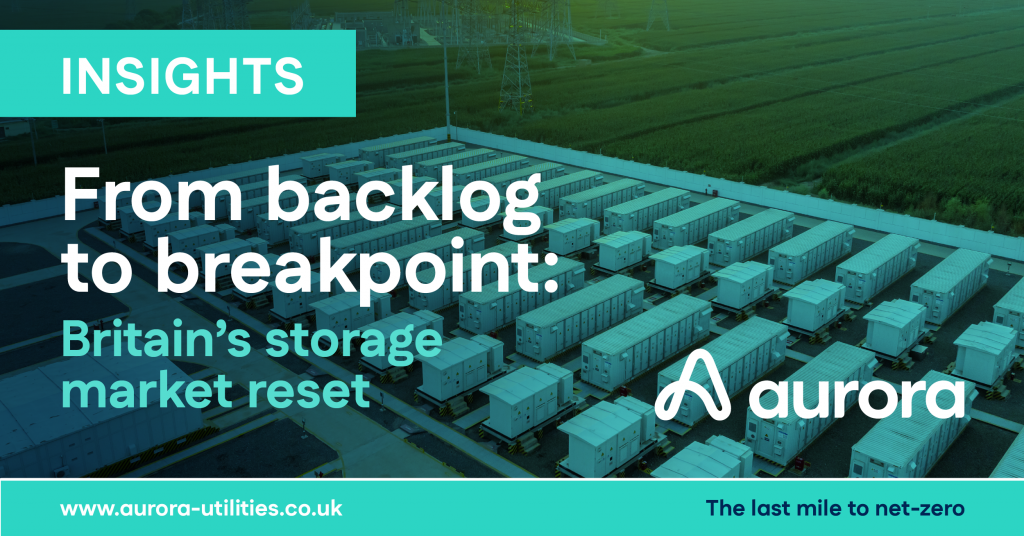
The Battery Energy Storage Systems (BESS) market in the United Kingdom is experiencing significant growth, increasingly driven by the integration of renewable energy sources and the need for grid stability. As of June 2024, the UK’s operational battery storage capacity reached 4.6 gigawatts (GW) with an energy capacity of 5.9 gigawatt-hours (GWh), and projections indicate an increase to 7.4 GW by the end of 2025.
Batteries hold the answer to many questions related to clean green intermittent energy. They allow flexibility in our energy generation and aid the inertia in the network required to keep the lights on. Whether stand alone or co-located with generation such as solar or wind, batteries can operate both in-front of the meter and behind-the-meter to support our energy demands.
The business case which supports the battery market is ever changing, revenue streams need to be stacked to provide bankable business models, and these revenue streams are constantly shifting. The capacity market which underpins the battery market only equates for roughly 15% of the revenue stream needed for a profitable business case, therefore detailed analysis of the markets is required.
Overhauling an outdated and unwieldy system
Although there is a merchant trading risk associated with the BESS sector, this has not yet discouraged investors flooding the marketplace. At the peak of the revenues in 2022, we saw a huge influx of grid applications with even larger project capacity secured, up to 1GW in some cases. The rush for connections has ended in a logjam, with queues for capacity and access to transformers and battery cells increasingly difficult.
This has resulted in an oversubscription of grid applications in the system which has ultimately resulted in the changes proposed in the Clean Power 2030 act to reduce the time to connect and removing many projects from the connection queues.
In February 2025, Ofgem kicked off the ‘radical reform’ of grid connection to move away from the previous ‘first come, first served’ policy. This will mean that projects which have planning consents in place will move up the queue in favour of less developed or “zombie” projects where capacity is being reserved with a view to selling the capacity for a profit. Many projects will fall out of the queue completely as it is estimated that the queue contains around four times more battery capacity than is required by the grid.
As Ofgem’s Director General for Infrastructure, Akshay Kaul, said recently, “This is a step change in tackling delays and shortening queues on what is currently an outdated and unwieldy system. Britain will not get a clean power grid by 2030 unless an unprecedented volume of new renewable power and storage is connected to electricity networks – that’s why we’re cutting back the red tape and replacing the out-of-date connections system.
“It will also help speed up connections for public services, including housing, hospitals and EV charging stations, as well as new industries like data centres which are key to boosting economic growth.”
The headwinds
Since the gold rush of 2022 we’ve seen battery revenues drop by as much as 70%, battery costs have fallen in line but other important rising costs of construction and other equipment such as transformers have not been enough to offset the falling costs of the batteries themselves. Also base interest rates have increased from just 0.25% in 2022, and peaked at 5.25% and remain at 4.75%, adding to the cost of capital. These headwinds have created more barriers to adoption, making the business case for battery projects much more challenging.
BESS projects today face a very different equation than just a few years ago. It’s not necessarily an equation that can’t be solved. However, it might require projects to be able to tap into that quality for which batteries were valued to begin with: flexibility.
A role for an IDNO
Historically BESS developers and operators have failed to tap into the capital available from utilising an IDNO. This may have been because the cost of connection was baked into the original development costs, the IDNO market was not actively pursuing these types of projects or simply developers of BESS were not aware of the IDNO ability.
However, with the rise in borrowing costs and the need to speed up connection dates, using an IDNO to connect you to the network is now an increasing attractive proposition. Using Aurora to connect your project offers the flexibility you require.
Giving developers the flexibility to choose between higher asset values for higher operational costs or lower asset values for lower operational costs is one way to provide flexibility. That may be in the form of maximising the asset value from the IDNO in exchange for slightly higher DUoS (distribution use of system) charges. Or for longer-term investors seeking to own and operate the BESS for the long-term, lower operational costs are more attractive which would result in a lower asset value from the IDNO. An IDNO can even stage capital payments over the life of the project, which can ultimately increase whole life cash flows for some projects.
Again, the key is flexibility, working with the project developer to add value, not cost. We work in partnership with the project developers, Independent Connection Providers (ICPs) and BESS operators. In addition to that, developers gain the usual benefits of working with an IDNO, such as quicker connection times and capabilities to support design, supply, installation and planning.
In the context of the UK’s National Energy System Operator (NESO) Clean Power 2030 (CP2030) plan, which was published in November and approved by Ofgem in February, that’s going to be crucial.
CP2030 states that BESS projects were among the most oversubscribed technologies in the connections queue. As with all development projects, demonstrating realistic plans and hitting project milestones will be critical to progressing projects. An IDNO can help ensure developers can achieve these milestones and speed up the connection process.
The opportunity for BESS is still huge but harnessing it might require some creative thinking. A little flexibility could go a long way.